Friday, August 24, 2012

Review: The Invention of Hugo Cabret and Wonderstruck

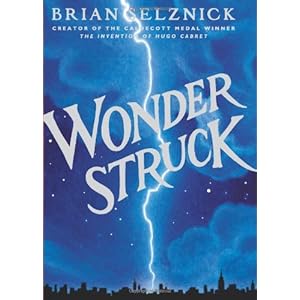
Last fall, I was in the bookstore and saw a huge stack of signed copies of Wonderstruck by Brian Selznick. I hadn't heard of the book, nor had I read his other well known book, The Invention of Hugo Cabret. I caved and bought Wonderstruck, because the cover was beautiful and the blurb mentioned the 1920s.

I didn't read it until recently, and it sat on my shelf for months. I finally decided to read The Invention of Hugo Cabret, because the movie previews I saw fascinated me and it looked like it would be a quick read.

I'm doing a joint review of these two books, as I read them in such quick succession.


The Invention of Hugo Cabret centers around a boy, Hugo, who has been orphaned and lives in a train station repairing the clocks in the station and repairing an automaton his father discovered. He befriends the goddaughter of the toy seller in the train station and discovers this man may be a famous filmmaker.

Wonderstruck intertwines the story of a young girl in 1920s New York/New Jersey and a boy living in Grand Marais, Minnesota 50 years later. Ben, the boy, has lost his mother, and after finding a note and address in a book about museums, he makes his way to New York to find his father.

Both of these books are works of art. Melznick uses illustration to not just supplement the text, but to serve as part of the text. In Wonderstruck, the story of the girl is only told through pictures and in Hugo, the illustrations take the place of the written word. The illustrations are beautiful and really add to the overall story.

Melznick obviously does his research in regards to both books. I loved the exploration of film history in Hugo and the dwelving into Minnesota in Wonderstruck. When he does deviate from history, it's obviously deliberate. I am somewhat of a loss for words in regards to both books. They were both beautiful and Melznick captures nostalgia so well. I was probably more moved by Wonderstruck, because it has a Minnesota connection, though I loved Hugo Cabret, as well.

These are both amazing and moving works of art.

Tuesday, August 7, 2012

Book Review: The Wednesdays

Author: Julie Bourbeau
Publisher: Random House Children's Books
Release Date: August 14, 2012
Pages: 256
Source: Netgalley
Why I read it: Got an ARC from Netgalley and the premise sounded interesting.

Summary: Max’s village is absolutely normal in every single way and on every single day—except Wednesday. Most of the townsfolk shutter their windows and lock their doors to hide away from the many peculiar things that happen—things like cats getting stuck in the vacuum cleaner and birthday cakes meeting fiery and horrific ends. But Max is too curious for that, and so, breaking every rule in the village, he searches out the cause of all the Wednesday weirdness. What he uncovers is a secret so devious—so dastardly and mischievous—that life as he knows it will never be the same. Max himself is not the same. Suddenly the mysterious little accidents so common on Wednesdays are happening to him on Thursdays, Fridays—even Saturdays! What’s come over Max? And more importantly, is there any cure for a case of the Wednesdays? Mystery, magic, mischief and monsters abound in this slightly fantastical story of a human kid who wants to stay that way.
What I thought: Max lives in a village that is pretty normal except on Wednesdays. One Wednesday, he discovers that there are creatures called the Wednesdays that cause mischief around the village. Soon he discovers that he has caught a "case of the wednesdays," and is turning into one of the Wednesdays. The plot centers around Max trying to understand the Wednesdays and how to stop his transformation.
I was pulled in because the premise of the book sounded interesting, and I liked the illustration on the cover. Who doesn't love quirky little towns? But when I found out that the "wednesdays" were actually monsters, I felt a little disappointed. I probably should have seen this coming, as the description alludes to it and the cover does as well. I guess it's a case of nothing is scarier. The plot was a little predictable and simplistic to me, and I was able to accurately guess plot developments. As for the characters, I liked Max. He was complex and showed bravery and apprehension at the same time. I did like the supporting characters as well; his parents being afraid of him, but at the same time caring about his well being; his relationship with his baby brother; his friends Noah and Gemma, who help him carry out his final plan; Mr. Grimsrud and Thursday helping at the very end; and finally, the mystical doctor that was both intelligent and bumbling.

While I did like the characters, I felt like the world wasn't explained enough. Who are the Wednesdays, why did they become Wednesdays, why are the older ones so evil? Why do they cause mischief? Why did they choose Max? What happened to One? I get that they are supposed to be somewhat mysterious, but I wanted to know a little more about the village and the Wednesdays.

Maybe it's just me, but I read the book as a metaphor for puberty. Max's body and feelings are changing, and it's a completely negative experience. He's frustrated by his family and people at school and imagines bad things happening to them. Because he has caught a case of the "wednesdays," bad things do happen. This reminded me of how teenagers have been accused of causing poltergeist activity. His body is also changing and his clothes no longer fit. He wants to go back to the way things are before, and he has to struggle against this transformation that is happening to him. Maybe this was an odd reading of the book, but that's instantly what I thought when he started outgrowing his clothes. Surely I'm not the only one that felt this way!

I would rate this 3ish stars. I didn't hate it, but I didn't fall in love with the book either. It was ok.

Friday, July 27, 2012

Review: Ella Enchanted

Author: Gail Carson Levine
Publisher: Scholastic Books
Release Date: January 1, 1997
Pages: 240
Source: Purchased
Why I read it: I saw the movie many years ago, and because I love fairy tale retellings, I figured it was time for me to read it.

Summary (from Goodreads): At birth, Ella is inadvertently cursed by an imprudent young fairy named Lucinda, who bestows on her the "gift" of obedience. Anything anyone tells her to do, Ella must obey. Another girl might have been cowed by this affliction, but not feisty Ella: "Instead of making me docile, Lucinda's curse made a rebel of me. Or perhaps I was that way naturally." When her beloved mother dies, leaving her in the care of a mostly absent and avaricious father, and later, a loathsome stepmother and two treacherous stepsisters, Ella's life and well-being seem to be in grave peril. But her intelligence and saucy nature keep her in good stead as she sets out on a quest for freedom and self-discovery as she tries to track down Lucinda to undo the curse, fending off ogres, befriending elves, and falling in love with a prince along the way. Yes, there is a pumpkin coach, a glass slipper, and a happily ever after, but this is the most remarkable, delightful, and profound version of Cinderella you'll ever read.

Gail Carson Levine's examination of traditional female roles in fairy tales takes some satisfying twists and deviations from the original. Ella is bound by obedience against her will, and takes matters in her own hands with ambition and verve. Her relationship with the prince is balanced and based on humor and mutual respect; in fact, it is she who ultimately rescues him. Ella Enchanted has won many well-deserved awards, including a Newbery Honor.


I was really looking forward to this book, because I read so many good reviews of it, plus I love fairy tale retellings. However, while I loved the concept and the characters, the execution was not the greatest.

I loved the character of Ella. She was cursed with the "gift" of obedience, but at the same time, still had her own agency and was independent. I loved how she fell in love slowly with the prince and there was no "instalove" which is one of my huge pet peeves. I even liked the minor characters. At first, I was worried that the stepmother and stepsisters were really one dimensional, and in many ways they were, but they had underlying insecurities. I noticed this particularly with Olive, the youngest stepsister, who feels lonely and while she is greedy and wants money, she also wants someone to listen to her. I thought all of the characters were interesting, and I think this is the highlight of the book.

However, the execution, particularly the pacing and some plot details were confusing to me. I felt that the book jumped around in little episodes and the pacing was not as fluid as it could have been. I also felt some elements in the plot came out of nowhere, like the boarding school and the magical book that Ella's fairy godmother gives her. I felt that the boarding school didn't really add anything to the plot, except giving her a best friend, Areida, who is sadly lacking in the rest of the book. The magical book was a little creepy, and seemed to be as a crutch to move the plot forward.
I also felt the resolution, where Ella is able to stop being obedient, while it did show that Ella had the power all along, it was also fueled by the prince, which seemed a little bit like a cop out to me.

Overall, I was a little disappointed with the execution, but I did like how the author used the traditional Cinderella tale and turned it upside down. Ella was obedient, but she struggled against it and had to find her own way to crush this obedience.

Wednesday, July 25, 2012

Waiting on Wednesday: The Diviners

Waiting on Wednesday is a weekly feature at Breaking the Spine.

My pick this week is The Diviners by Libba Bray. This will be released in September 2012. I've read other books by Libba Bray and I have liked them, but the description of this one sounds just like something I would love. I love the name of the museum, "The Museum of American Folklore, Superstition, and the Occult." Can't wait!

Summary (from Goodreads): Evie O'Neill has been exiled from her boring old hometown and shipped off to the bustling streets of New York City--and she is pos-i-toot-ly thrilled. New York is the city of speakeasies, shopping, and movie palaces! Soon enough, Evie is running with glamorous Ziegfield girls and rakish pickpockets. The only catch is Evie has to live with her Uncle Will, curator of The Museum of American Folklore, Superstition, and the Occult--also known as "The Museum of the Creepy Crawlies."
When a rash of occult-based murders comes to light, Evie and her uncle are right in the thick of the investigation. And through it all, Evie has a secret: a mysterious power that could help catch the killer--if he doesn't catch her first.

Friday, July 20, 2012

Review: The Mastermind Plot

Author: Angie Frazier
Publisher: Scholastic Inc.
Release Date: March 1, 2012
Pages: 240
Source: Library
Why I read it: I read the first book in the series.
Summary (from Goodreads): A new, exciting Suzanna Snow adventure!Suzanna "Zanna" Snow can hardly believe her luck: She's just arrived in Boston, the city she's wanted to visit for as long as she can remember. Think of all the mysteries waiting to be solved here! Her grandmother and cousin, Will, welcome her warmly, but her famous detective uncle, Bruce Snow, seems anything but pleased. He doesn't want Zanna meddling in his current case involving a string of mysterious warehouse fires along the harbor front. But Zanna can't help herself. Is someone setting the fires? Just when she thinks she's on to something, a strange man starts following her. Is he a threat? Zanna needs to solve the case before she has the chance to find out.

What I thought: This is the second book in the Suzanna Snow series of mysteries. I feel like these books barely get mentioned on the internet, and I wish more people read them. I read the first one a while ago, so I can not remember all the plot details, especially the mystery, but I do remember the characters. Zanna is a great character. She's very plucky, curious and resourceful, very much an Edwardian Nancy Drew. While she is very plucky, I think she is also true to the time she lives in. She realizes that she is restrained by being a girl, but manages to work within these boundaries, even though she is forced into a girl's school along with other social restrainments she experiences. 

I also like, in this book and in the former, the dynamics between Zanna and the adults around her. While Zanna is obviously the most memorable character, I think her Uncle Bruce is the second most memorable character. He obviously does not think highly of children and is very dismissive of Zanna, which frustrates Zanna, as well as many other characters. And it frustrates me! Especially when Zanna was originally a big admirer of her uncle. An underlying theme to the series is the interaction between adults and children, and how children are easily dismissed and not believed. This is a typical theme for children's books, especially middle grade. Middle grade readers, and Zanna are frustrated by the adults, but the readers can see how Zanna is able to deal with this.

I enjoyed the book. It is a quick, light read, but I found the mystery a little easy to figure out, which is also how I felt about the first book in the series. I rarely am able to "figure out" the mystery while reading mystery books, but with both of these books, I figured it out pretty quickly. These are middle grade books, and I do not think they should be or are dumbed down, but I think this has made the mystery a little too simplistic for me. Maybe Nancy Drew was this way, too. It has been so long since I've read them that I cannot remember!

I read another review that commented that Zanna stumbled onto the solution of the mystery in comparison to the first book. As I wrote before, I don't remember all the details of the mystery from the previous book, but I find the other reviewer's comments to be true. I feel like Zanna did not put all the pieces of the puzzle together and was almost there when she walks into the resolution. I wish she had figured it out on her own, before being told the who, what and why.

I was a little surprised by the big twist at the end involving the strange man who was following Zanna. I don't want to reveal the twist, but I am interested to see where the author goes with this twist in subsequent books. It could add a very interesting dynamic to the story.

Overall, I find this series to be enjoyable, and I like the characters. I will continue reading the rest of the series

Tuesday, July 17, 2012

A-Z Challenge


I found this challenge in a group on Goodreads. The goal is to read 26 Young Adult books in 2012. Each book's title or author must start with one letter from the alphabet. So my shelf on Goodreads looks neat, I am trying to read books alphabetically by title. This is proving hard for the letter Q. I also have a couple of non YA books on my list, but most of the list is YA.

So far I have read half of my list, which is pretty good, I think! This list may change and has gone through many changes, but here is what I have read/will read:


A - An Artificial Night by Seanan McGuire (finished June 15, 2012)

B - Blackwood by Gwenda Bond

C - Cinder by Marissa Meyer (finished April 24, 2012)

D - Divergent by Veronica Roth (finished May 3, 2012)

E - Ella Enchanted by Gail Levine

F - Fury by Elizabeth Miles

G - The Girl Who Owned a City by O. T. Nelson (finished January 8, 2012)

H - Heist Society by Ally Carter (finished February 15, 2012)

I - Impossible by Nancy Werlin

J - Jazz in Love by Neesha Meminger

K - The Killing Moon by N. K. Jemisin

L - Lips Touch Three Times by Laini Taylor (finished February 29, 2012)

M - Me and Earl and the Dying Girl by Jesse Andrews (finished January 17, 2012)

N - The Name of the Star by Maureen Johnson (finished May 9, 2012)

O - Open Minds by Susan Kaye Quinn

P - Paranormalcy by Kiersten White

Q - The Queen of Kentucky by Alecia Whitaker

R - The Ruby in the Smoke by Phillip Pullman (finished June 30, 2012)

S - Struck by Jennifer Bosworth (finished April 13, 2012)

T - Texas Gothic by Rosemary Clement-Moore (finished June 27, 2012)

U - Unholy Ghosts by Stacia Kane

V - The Veil of Gold by Kim Wilkins

W - The Wednesdays by Julie Bourbeau (finished April 3, 2012)

X - XVI by Julia Karr

Y - The Year of the Beasts by Cecil Castellucci (finished June 18, 2012)

Z - Zoo City by Lauren Beukes (finished March 15, 2012)


Book Review: 13 Little Blue Envelopes

Author: Maureen Johnson
Publisher: Harper Collins Publishers
Release Date: September 26, 2006
Pages: 319
Source: Library
Why I read it: I had read another book by this author and the concept intrigued me.
Summary: (from Goodreads)  When Ginny receives 13 little blue envelopes with instructions to buy a plane ticket to London, she's soon on an adventure that will change her in more ways than one.

What I thought: I have mixed feelings about this book. I loved the concept. A European/traveling adventure is my dream come true, especially one that involves a little mystery and discovering one's self. But I did have some issues with the book.

The concept, though I liked it, was very unrealistic. I can't believe that Ginny's parents, especially her mother, who seem to dislike Ginny's aunt, would let Ginny run off to a foreign country with only her backpack and some money. I think if Ginny had been a little older, maybe had just graduated or was in college, I would have found this more believable.

I felt that Ginny's characterization was not very well developed. She just seemed to let things happen to her, instead of propelling herself forward. Granted, her instructions were sometimes not clear, but she seemed passive in a lot of cases. I can see how the author intended the letters and her adventure to be a sort of coming of age story, but I felt that Ginny was sometimes a little stupid about her actions, especially when she went to Rome and her traveling with a family in the Netherlands.

I did like the characterization of Ginny's Aunt. I loved Aunt Peg at first, but as the novel wore on, she angered me with her flightiness. I liked how Johnson showed Peg as both admirable and also very irresponsible. Ginny obviously idealized her, and I wanted to idealize her, too, but Ginny was able to see how Peg was a deeply flawed person and easily ran away from her commitments. I think this understanding about her aunt was the most compelling part of the story.

That seems to be the whole point of the story to me, Ginny is bland and seems numb until she moves outside of her comfort zone. Aunt Peg's letters helped her to come alive and run off and have an adventure, but also, unlike Aunt Peg, Ginny is able to understand that personal connections are very important. Aunt Peg doesn't seem to learn this lesson until she is dying. I was touched when I learned that Peg and Richard (the first person Ginny stays with in London) had fallen in love, even though Richard doesn't learn this until after Peg dies. I teared up a little at the end, especially when Ginny writes the final letter to her aunt.

I also liked the travel parts of the novel, and Johnson clearly did her research. I have not visited all the places, but I think Johnson made them come alive in the novel. I like how Johnson sets books outside of the United States and they seem to be well researched.

Overall, I enjoyed the book with some reservations, especially in regards to the believeability of the plot. It was a nice, quick summer read.